Sunday, May 23, 2010
Our Garden
Last year, the focus of most of the work here was on building. This year, Cliff and the apprentices are really working the garden. Garrison, Nilsa, and Rich have all spent many hours in the greenhouse and garden, setting the stage for an abundance of home grown food. These apprentices leave on June 5th, so they probably won't get to eat what they've worked so hard to get in the ground. So, thanks, you three, we really appreciate all your work!
Garrison gave me a tour of the new plantings a few days ago. Among the bounty, we've got tomatoes, peppers, okra, corn, melons, and cucumbers. As he walked around showing me where all of these are, it reminded me of my grandparents' back yard. My father's parents grew up in the rural South during the Great Depression, and always kept a food garden going. I'll always remember sitting on the floor by my grandma's chair snapping beans and talking.
Backyard gardens used to be the norm. With the advent of modern convenience foods, and most families current need for two incomes, the small garden seems like a thing of the past. Not so! More and more people are finding joy in getting their hands dirty and growing healthy, fresh, (sometimes even organic) food. Like my daddy always says: Only two things money can't buy. That's true love and home grown tomatoes!

Friday, May 21, 2010
The ETC Now on Facebook
The Ecovillage training center is now catching up with the rest of the social networking world. We're blogging, we're podcasting, we're on youtube, and now we've even got our very own fan page on facebook. Swing by and check it out at facebook.com/ecovillagers.
Saturday, May 15, 2010
Learning About Ducks

The big news this week was the arrival of our fourteen female ducklings. Shipped to us the day they hatched, we received the little peeping balls of fuzz with coos and cries of, "Awww, those are the cutest things ever!" (I believe that last one was uttered mostly by yours truly.)
I didn't know much of anything about caring for ducklings when they got here. Another staff member, KMO, has had experience with baby chickens, so I assumed he would be the primary "duck mamma." I didn't count on the fact that I would fall head over heels in love with the little sweeties and want to make sure they have every chance of surviving to becoming adult egg-laying, tick-munching members of the ETC family. In addition to my tendency to go dewy eyed in the presence of the ducklings, KMO left this morning for a ten day trip. While he's away, I'll be sleeping in the bedroom next to the attached greenhouse (their current home) to respond to any cries of distress in the night, and making sure they have plenty of fresh water and food during the day.
So, in preparation for my duck mamma duties, I turned to the internet for guidance. What I got was a bunch of conflicting advice about bedding and swimming lessons, but pretty consistent views on food and heat. Here's what we're doing at the ETC.
- Housing & Bedding: The babies are housed in a wooden box without a lid. During the night, we put a rectangle of metal screening on the top and weigh it down with bricks to prevent mice or rats getting it. Their original bedding was straw, but it was quickly soaked and soiled. We changed to a commercial pine shaving bedding. It still gets very wet and soiled, but exec pt for right next to the water dish, the dampness and feces seem to be confined to the top layer. This makes it easier to clean on a daily basis. Some websites on duckling care warned against pine shavings due to the duck's tendency to try to eat it. Ours did try it out at first, but quickly spit out most of what they tasted, deeming it "icky." They've had the pine bedding for two days, and are all still alive and kicking.
- Heat: The ducklings' home is in a greenhouse that maintains a daytime temp of high 70's to mid 80's depending on cloud cover. We've got a heat lamp clamped to the side of the box, and keep an eye on their behavior to determine whether it's too hot. From what I understand, they should be at a temp of about 90-95 degrees, gradually decreasing it after about 10-ish days.
- Food & Water: We're feeding them a non-medicated 20% starter/grower chick feed. Its small crumbles are perfect for little bills. According to the bag, we should switch to the pellet form at about ten weeks. The food is served in a purchased UFO-shaped feeder with holes cut out of the top. The perforated lid allows the ducklings access to the food without it spilling all over the place. The water has been a learning experience. They drink (and spill) a lot of water. The water dish consists of a quart ball jar with the dish part screwed on top. It's turned upside down and gravity feeds the water into the dish as the ducks drink it. Ducks are dabblers, and drop food in the water and sprinkle it all over their bedding in the blink of an eye. We check the water at least once an hour, and refill the jar many times a day. I've taken to putting the water dish up on a platform of a couple of smooth bricks, so that the ducklings don't stand in the wet bedding while trying to drink.
- Swimming Lessons: Nothing yet, so far. I've read conflicting advice, saying that they can have supervised swimming in shallow water from day one, or that they shouldn't be in water until their true feathers grow in at about 9-12 weeks.
That's pretty much it right now. On their first day here, I took a little video of their cuteness and posted it to youtube. Here are the little ones in their cinematic debut: Cute Baby Ducks.
Thursday, April 29, 2010
Bamboo as Food
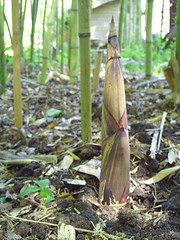
One of the goals here at the ETC is to teach people how to grow their own food. We do that in a number of ways, incorporating both gardening and wildcrafting. Oftentimes, as in the case of our numerous bamboo stands, the line between the two techniques blurs a bit.
As the weather in central Tennessee gets warmer and wetter, our bamboo is doing its best to spread itself out into any path, lawn and garden area it happens to border. Bamboo rarely flowers and seeds. Instead, its root (called a rhizome) sends up new shoots that will eventually grow into the tall, sturdy, wood-like grass that we use around here for our natural building projects. These little dark points may seem like a nuisance to those who don't know their secret: they're food! Ever wonder what the little white, crunchy rectangles in Chinese takeout are? Yup, that's bamboo.
Two days ago, a baking dish full shoots appeared in the kitchen, courtesy of Cliff and the apprentices. They harvested the baby bamboos from the yard in an attempt to control the growth, and we ended up with wild-ish, organic, as local as you can get food. Woot! So far, we've added them to chilli and soup, both of which were inspired by recipes from The New Farm Vegetarian Cookbook. We simply peeled off the tough, dark outer leaves and fried the chopped hearts in olive oil with onions and garlic. Cliff, who is homesteading with his wife and two children, recommends boiling them with pickling spices for a yummy treat. Then, the juice can be used in soups to give them a little kick. Ellie, an intern over at Adam Turtle's nearby bamboo nursery, eats the inside of the young shoots raw! Be aware, though, that some sources say that uncooked bamboo shoots can be toxic and should be parboiled before use.
For a run-down on the nutritional value of this easy-to-grow, easy-to-cook, easy-to-enjoy semi-wild food, check out this article on about.com.
Sunday, April 25, 2010
Our New Herb Spiral
Our old kitchen garden herb spiral was looking a little ragged, so Cliff and the apprentices (along with the help of our first EcoSoaker, Joel) gave it a face lift.
An herb spiral is a beautiful way to create a diverse herb garden in a small space. It is basically a mound of soil, with a spiral of rocks winding its way up to the top. Plants that like different amounts of sun and soil moisture can live together comfortably on an herb spiral. Ones, such as basil, that handle a fair amount of sun can hang out on the south and west side, while plants that thrive in cooler shade can survive on the north side and east. We planted some micro greens and perennial kale on our north side. Have a plant that likes dryer soil? It goes right on top. We even added a water feature at the bottom of the spiral that's giving a home to some cattails. It was a lovely way to spend Earth Day.
When I say "we" I really mean Cliff, Garrison, Nilsa and Joel. What did I do? Well, a little rock arranging, and a lot of picture taking. Here's the short how-to video I made of the pics I took.
An herb spiral is a beautiful way to create a diverse herb garden in a small space. It is basically a mound of soil, with a spiral of rocks winding its way up to the top. Plants that like different amounts of sun and soil moisture can live together comfortably on an herb spiral. Ones, such as basil, that handle a fair amount of sun can hang out on the south and west side, while plants that thrive in cooler shade can survive on the north side and east. We planted some micro greens and perennial kale on our north side. Have a plant that likes dryer soil? It goes right on top. We even added a water feature at the bottom of the spiral that's giving a home to some cattails. It was a lovely way to spend Earth Day.
When I say "we" I really mean Cliff, Garrison, Nilsa and Joel. What did I do? Well, a little rock arranging, and a lot of picture taking. Here's the short how-to video I made of the pics I took.
Wednesday, April 21, 2010
ETC Voices Podcast
Hi there. I'm KMO, host and producer of the C-Realm Podcast. I'm currently living at the ETC and trying to find a useful role to play here. I've been keeping a blog called KMO's ETC Journal to document my experiences here at the ETC and describe how those experiences are interfacing with my usual flotilla of concerns that I address each week on the C-Realm Podcast. To supplement the written material in the blog I have recently created an ETC photogroup on Flicker and a new podcast called ETC Voices. Eventually, that podcast will have its own rss feed and homepage and be available through iTunes, but for the moment you can only find it on my blog or on the Internet Archive.
The Feedback Loop in Community Communicaiton
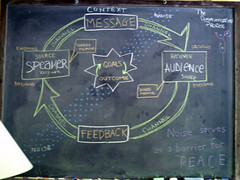 Communication is at the heart of a healthy community. Feeling safe to express both appreciation and concern to your cos* is important for a vibrant and fluid, yet stable, group relationship.
Without a clear chain of command or a traditionally structured student/teacher model here at the ETC, it can be a little confusing for the new apprentices to know who to talk to about their reflections on the program. Last week Cliff sat down with the apprentices, KMO and me to talk about how the evolution of the apprenticeship program reflects a natural system, such as a forest or prairie.
Instead of the main stream approach to teaching, where the instructor draws up a detailed syllabus with specific plans for each week, the Permaculture Immersion Apprenticeship Program mimics the regrowth pattern that happens in the space left by a downed tree in the forest. While there are planned projects for the season, and an overarching view of what needs to be accomplished by the end of an apprenticeship, the first week or so of the program may seem a bit chaotic. Just like the myriad of small plants and saplings that spring up in the new sunshine left by a hole in the forest canopy, the first few days of the program is about trying new ideas and getting a feel for what works and what doesn't.
Each group of apprentices comes in with its own expectations and desires to learn about one subject or another. We love that, and work with them to establish a schedule that accommodates both their passions and the ETC's need to accomplish the planned projects. And just like the seemingly patternless growth of random plants in the space around the downed tree, the chaos eventually falls into a pattern. Healthy, strong, fast growing saplings eventually shade out the weaker, smaller ones. As coordinators communicate the overreaching vision for the program and start offering suggestions as to what could happen first, the apprentices are encouraged to give feedback. The feedback is considered, and new suggestions may be made.
Once a schedule is agreed upon, then it's up to both the apprentices and the coordinators to keep communicating during the apprenticeship to make sure that everyone is included to their desired level and that the project gets completed within the agreed upon time frame. Some of our feedback tools include a "check-in" where coordinators and apprentices get a chance to talk about what's going well and what's challenging, an "intention blackboard" where apprentices and coordinators can write in their ideas about projects for the near future, and a co-counseling technique called "think and listen" where apprentices have a chance to process what they learned during the previous week.
These tools, along with informal chit-chat around meals or work, give space for a healthy community to flourish. Hopefully, the community that develops will prove to be as beautiful, rich, resilient and diverse as the forest that surrounds us here at the ETC.
*Co, which stands for community member, is a non gender specific pronoun commonly used in intentional communities which support gender identification freedom of choice.
Subscribe to:
Posts (Atom)