Showing posts with label Ecovillage Training Center. Show all posts

Sunday, July 25, 2010

Ask the ETC 3: Greay Water Wetlands

Last Thursday, I blogged about our daily habits that help conserve water, such as taking navy showers and using native plants in our landscaping. Instituto de Inglés América left a comment asking:

What do you do with the water used in the shower or from rinsing the dishes? What about the laundry?


In this episode of Ask the ETC Jason Deptula, our site manager, talks about how we filter our gray water through our constructed wetlands.

Click here to listen to episode three of Ask The ETC. Like what you hear? You can subscribe to the podcast on itunes at asktheetc.podomatic.com!

Friday, July 16, 2010

Ask the ETC 2: What to expect here at the ETC.

This week Paul, a current apprentice, talks about what to expect when coming in as either an apprentice or an EcoSoaker for our Permaculture Immersion Apprenticeship at the ETC. He lists off some items he has found useful, then riffs on the learning opportunities available here.

Click here to listen to Episode 2 of Ask The ETC.

Sunday, May 23, 2010

Our Garden


Last year, the focus of most of the work here was on building. This year, Cliff and the apprentices are really working the garden. Garrison, Nilsa, and Rich have all spent many hours in the greenhouse and garden, setting the stage for an abundance of home grown food. These apprentices leave on June 5th, so they probably won't get to eat what they've worked so hard to get in the ground. So, thanks, you three, we really appreciate all your work!

Garrison gave me a tour of the new plantings a few days ago. Among the bounty, we've got tomatoes, peppers, okra, corn, melons, and cucumbers. As he walked around showing me where all of these are, it reminded me of my grandparents' back yard. My father's parents grew up in the rural South during the Great Depression, and always kept a food garden going. I'll always remember sitting on the floor by my grandma's chair snapping beans and talking.

Backyard gardens used to be the norm. With the advent of modern convenience foods, and most families current need for two incomes, the small garden seems like a thing of the past. Not so! More and more people are finding joy in getting their hands dirty and growing healthy, fresh, (sometimes even organic) food. Like my daddy always says: Only two things money can't buy. That's true love and home grown tomatoes!

Saturday, May 15, 2010

Learning About Ducks


The big news this week was the arrival of our fourteen female ducklings. Shipped to us the day they hatched, we received the little peeping balls of fuzz with coos and cries of, "Awww, those are the cutest things ever!" (I believe that last one was uttered mostly by yours truly.)

I didn't know much of anything about caring for ducklings when they got here. Another staff member, KMO, has had experience with baby chickens, so I assumed he would be the primary "duck mamma." I didn't count on the fact that I would fall head over heels in love with the little sweeties and want to make sure they have every chance of surviving to becoming adult egg-laying, tick-munching members of the ETC family. In addition to my tendency to go dewy eyed in the presence of the ducklings, KMO left this morning for a ten day trip. While he's away, I'll be sleeping in the bedroom next to the attached greenhouse (their current home) to respond to any cries of distress in the night, and making sure they have plenty of fresh water and food during the day.

So, in preparation for my duck mamma duties, I turned to the internet for guidance. What I got was a bunch of conflicting advice about bedding and swimming lessons, but pretty consistent views on food and heat. Here's what we're doing at the ETC.
  • Housing & Bedding: The babies are housed in a wooden box without a lid. During the night, we put a rectangle of metal screening on the top and weigh it down with bricks to prevent mice or rats getting it. Their original bedding was straw, but it was quickly soaked and soiled. We changed to a commercial pine shaving bedding. It still gets very wet and soiled, but exec pt for right next to the water dish, the dampness and feces seem to be confined to the top layer. This makes it easier to clean on a daily basis. Some websites on duckling care warned against pine shavings due to the duck's tendency to try to eat it. Ours did try it out at first, but quickly spit out most of what they tasted, deeming it "icky." They've had the pine bedding for two days, and are all still alive and kicking.

  • Heat: The ducklings' home is in a greenhouse that maintains a daytime temp of high 70's to mid 80's depending on cloud cover. We've got a heat lamp clamped to the side of the box, and keep an eye on their behavior to determine whether it's too hot. From what I understand, they should be at a temp of about 90-95 degrees, gradually decreasing it after about 10-ish days.

  • Food & Water: We're feeding them a non-medicated 20% starter/grower chick feed. Its small crumbles are perfect for little bills. According to the bag, we should switch to the pellet form at about ten weeks. The food is served in a purchased UFO-shaped feeder with holes cut out of the top. The perforated lid allows the ducklings access to the food without it spilling all over the place. The water has been a learning experience. They drink (and spill) a lot of water. The water dish consists of a quart ball jar with the dish part screwed on top. It's turned upside down and gravity feeds the water into the dish as the ducks drink it. Ducks are dabblers, and drop food in the water and sprinkle it all over their bedding in the blink of an eye. We check the water at least once an hour, and refill the jar many times a day. I've taken to putting the water dish up on a platform of a couple of smooth bricks, so that the ducklings don't stand in the wet bedding while trying to drink.

  • Swimming Lessons: Nothing yet, so far. I've read conflicting advice, saying that they can have supervised swimming in shallow water from day one, or that they shouldn't be in water until their true feathers grow in at about 9-12 weeks.

That's pretty much it right now. On their first day here, I took a little video of their cuteness and posted it to youtube. Here are the little ones in their cinematic debut: Cute Baby Ducks.


Sunday, April 25, 2010

Our New Herb Spiral

Our old kitchen garden herb spiral was looking a little ragged, so Cliff and the apprentices (along with the help of our first EcoSoaker, Joel) gave it a face lift.

An herb spiral is a beautiful way to create a diverse herb garden in a small space. It is basically a mound of soil, with a spiral of rocks winding its way up to the top. Plants that like different amounts of sun and soil moisture can live together comfortably on an herb spiral. Ones, such as basil, that handle a fair amount of sun can hang out on the south and west side, while plants that thrive in cooler shade can survive on the north side and east. We planted some micro greens and perennial kale on our north side. Have a plant that likes dryer soil? It goes right on top. We even added a water feature at the bottom of the spiral that's giving a home to some cattails. It was a lovely way to spend Earth Day.

When I say "we" I really mean Cliff, Garrison, Nilsa and Joel. What did I do? Well, a little rock arranging, and a lot of picture taking. Here's the short how-to video I made of the pics I took.

Wednesday, April 21, 2010

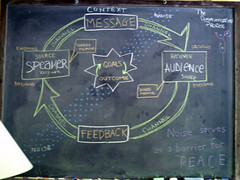
The Feedback Loop in Community Communicaiton

Communication is at the heart of a healthy community. Feeling safe to express both appreciation and concern to your cos* is important for a vibrant and fluid, yet stable, group relationship.

Without a clear chain of command or a traditionally structured student/teacher model here at the ETC, it can be a little confusing for the new apprentices to know who to talk to about their reflections on the program. Last week Cliff sat down with the apprentices, KMO and me to talk about how the evolution of the apprenticeship program reflects a natural system, such as a forest or prairie.

Instead of the main stream approach to teaching, where the instructor draws up a detailed syllabus with specific plans for each week, the Permaculture Immersion Apprenticeship Program mimics the regrowth pattern that happens in the space left by a downed tree in the forest. While there are planned projects for the season, and an overarching view of what needs to be accomplished by the end of an apprenticeship, the first week or so of the program may seem a bit chaotic. Just like the myriad of small plants and saplings that spring up in the new sunshine left by a hole in the forest canopy, the first few days of the program is about trying new ideas and getting a feel for what works and what doesn't.

Each group of apprentices comes in with its own expectations and desires to learn about one subject or another. We love that, and work with them to establish a schedule that accommodates both their passions and the ETC's need to accomplish the planned projects. And just like the seemingly patternless growth of random plants in the space around the downed tree, the chaos eventually falls into a pattern. Healthy, strong, fast growing saplings eventually shade out the weaker, smaller ones. As coordinators communicate the overreaching vision for the program and start offering suggestions as to what could happen first, the apprentices are encouraged to give feedback. The feedback is considered, and new suggestions may be made.

Once a schedule is agreed upon, then it's up to both the apprentices and the coordinators to keep communicating during the apprenticeship to make sure that everyone is included to their desired level and that the project gets completed within the agreed upon time frame. Some of our feedback tools include a "check-in" where coordinators and apprentices get a chance to talk about what's going well and what's challenging, an "intention blackboard" where apprentices and coordinators can write in their ideas about projects for the near future, and a co-counseling technique called "think and listen" where apprentices have a chance to process what they learned during the previous week.

These tools, along with informal chit-chat around meals or work, give space for a healthy community to flourish. Hopefully, the community that develops will prove to be as beautiful, rich, resilient and diverse as the forest that surrounds us here at the ETC.

*Co, which stands for community member, is a non gender specific pronoun commonly used in intentional communities which support gender identification freedom of choice.

Sunday, April 18, 2010

Chicken Tractor 2010

To welcome our new chickens, the apprentices and Cliff built them a spiffy chicken tractor. This way we can let them forage in a controlled manner, helping us to weed, de-bug, and fertilize the garden without tearing up what we've planted.

I hung around and took a bunch of pictures while they were building. Here's some of the best, in a simple how-to slide show. Hope you enjoy it!


-Merry

Wednesday, April 7, 2010

We Welcome Our First Group of Apprentices

Our Permaculture Immersion Apprenticeship program is now in full swing. These two month apprenticeships combine organic gardening, natural building and community living in order to give the apprentices a taste of what it is like to live and work in an ecovillage setting.

Our goal in creating this program is to promote systemic social changes towards sustainable human habitats and to encourage loving personal growth, free artistic expression, caring relationships, deep environmental awareness, and celebration of cultural and individual differences. We hope to inspire people to work for something bigger than themselves.


Here's Cliff, our apprenticeship coordinator.

Our first group of apprentices will be staying with us through the end of May.

Nilsa: I'm from Cape Coral, FL and volunteer at ECHO in North Fort Myers,FL. http://www.echonet.org/ It's an awesome organization. I'm here to learn all I can regarding permaculture and natural building to utilize these skills in a third wold application, sustainability. I also am involved with local area community gardening. In a nutshell, I would love to learn these skills well enough to teach them to others in the near future, God willing.

Rich: Thirty year old explorer of life, Rich, is looking forward to getting some chickens laying eggs at the Ecovillage Training Center. This, of course, will require a chicken tractor (or two) being built, but Cliff and the ETC apprentices seem gung ho about the idea. The project will be a great learning experience for Rich to take back to Twin Oaks, when he returns there for membership in June.
Rich was also excited to find a potential solar cooker today in the dome near the ETC, but more investigation is necessary. A little over 24 hours into his apprenticeship, the northern Virginia native is excited about the swimming hole, the abundance of items at the The Farm Store, the potential for a soccer game on the big field and whatever else The Farm may bring.
Although this is the 7th community Rich visited in the past two months, traveling Virginia, North Carolina and Tennessee, there lay many possibilities in what should be the longest visit this year, at The Farm.


Garrison: Garrison F. Creamer originates from Panama City, FL and serves as the director and founder of the Gulf Coastal Free Currency Coalition and BeachForest Harmony, an investment bank which seeks to redistribute capital to sustainable communal development through private and voluntary currencies. Co* has experienced firsthand the effects of the housing boom caused by artificially injected capital into circulation and witnessed the destruction of co's natural environment at a time when the Florida panhandle was the most viable and desired real estate investment. After completing this internship co plans to devote the rest of co's life to the practices of permaculture and Austrian economics. Co is also an avid surfer who loves to travel and find new waves!


-Merry

*Co, which stands for community member, is a non gender specific pronoun commonly used in intentional communities which support gender identification freedom of choice.

Monday, April 5, 2010

Big Plans at the Ecovillage Training Center for 2010

Hi, I’m Merry, the new innkeeper of the ecohostel at the ETC. I lived here on The Farm for four months last summer, both apprenticing and working. I was tickled pink to accept the position of innkeeper for this summer, and am looking forward to an amazing season!

We’ve got a lot of exciting things planned this year at the Ecovillage Training Center. Cliff is heading up our Permaculture Immersion Apprenticeship, with plans for organic gardening and natural building. I’ll be helping him to integrate the garden and the kitchen by working with the apprentices on things like food preparation and preservation. He’s already started micro greens and radishes in the green house, and the garlic is really doing its thing in the garden. I’m having visions of marinated chard, roasted garlic, and radish butter spread on fresh bread. Yum!

Jason and Alayne are back again this year, as site manager and inn manager. They are in the process of building a home here on The Farm, and are using natural building techniques such as cordwood and light clay straw. They both look forward to welcoming the apprentices and have plans for fun work days out at their place. Later this season Jason, along with other builders on The Farm, will be giving the inn a big face lift. The renovation will give us new sleeping quarters, new inside and outside common areas, and a brand new kitchen.

We also welcome a new face to the ETC this year. KMO, who produces a weekly podcast called the c-realm, is joining the crew. He’ll be managing the bookstore, and setting up an online presence for it. Pretty soon you’ll be able to order titles like Creating a Life Together: Practical Tools to Grow Ecovillages and Intentional Communities by Diana Leafe Christian, or The Post-Petroleum Survival Guide and Cookbook by Albert Bates, either directly from us or through our Amazon store. There’s even talk of possibly setting up an etsy.com shop for Farm residents to sell their crafts through.

Speaking of Albert, he’s been traveling and staying in other ecohostels lately, and has some great ideas for creating a relaxed, fun, inviting atmosphere here at the inn. I can’t wait to chat with him on his vision for the hostel. (I’ve heard mumblings about planned canoe trips.)

And if those aren’t enough plans for the summer, I’ll also be hosting a regular vegetarian potluck at the hostel. If you’re in the area on the second Saturday of the month, drop by with some food. (Eggs and dairy are ok, but no meat or broth based dishes, please.) Things will get rolling about 6:30pm. Hope to see you soon!

-Merry

Friday, October 10, 2008

Orchard Remediation

Wandering through the old orchards of the Farm with Brother Martin, our advanced permaculture course and Ecovillage Training Center Apprentices got a chance to hear stories about starting an orchard and and start brainstorming designs to improve the healthy and productivity of the Orchards, and perhaps even transition them into an forest gardening system.
We have been making gallons of gallons of Cider, and drinking it fresh and putting some up to ferment...perhaps I will get a chance to post up some FAQs and DIY in a couple days